Efflorescence: Understanding Efflorescence
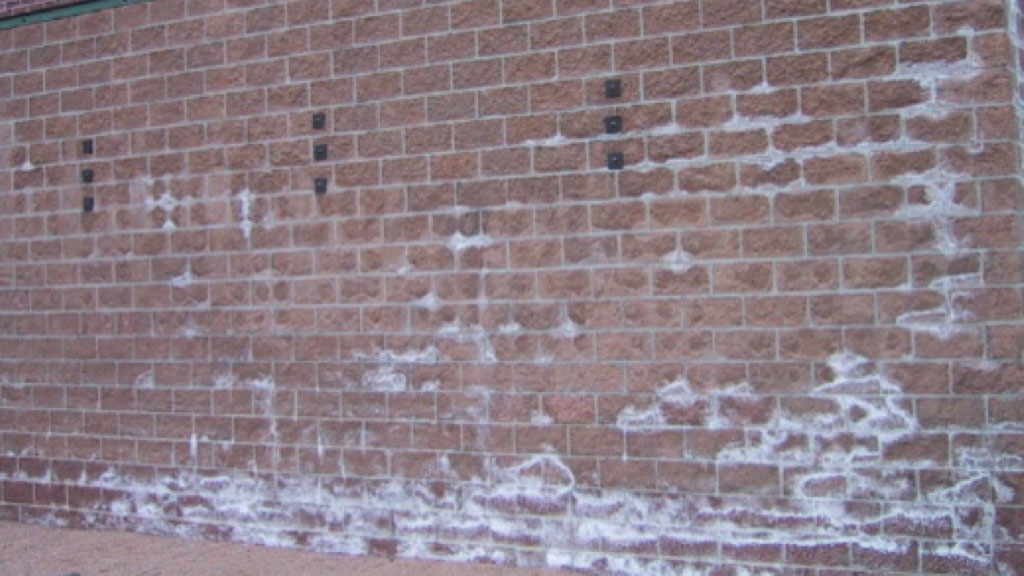
Masonry efflorescence.
You may have seen a white, powdery deposit show up on masonry walls soon after construction. Other times white stains appear years later, hard as rock and nearly impossible to remove. Both of these phenomena, called “efflorescence,” form when water moving through walls leave salts at the wall face. Efflorescence is more commonly observed during cool, damp weather or at areas shaded from direct sunlight such as on the north side of a building. Under these conditions internal moisture is slower to evaporate and is better able to dissolve salts.
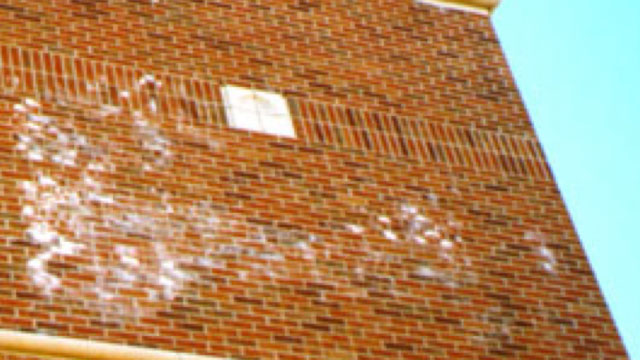
Masonry efflorescence.
Efflorescence is caused by a simple process: salts dissolve in water present in wet walls. As the wall dries out, water evaporating at the wall face leaves behind salt deposits. Efflorescence may form at mortar joints, on clay brick, concrete block, natural stone, or manufactured stone. It most commonly appears as a white surface deposit of salt crystals, but in some conditions may develop beneath the wall surface or appear as green, brown, or gray stains.
The primary concerns with efflorescence are its effect on masonry appearance and determining proper cleaning procedures necessary for its removal. While not immediately damaging, the presence of efflorescence indicates moisture is present in the wall. Moisture can lead to long-term deterioration and staining if left untreated. Under certain conditions salts may form just beneath the wall surface as “cryptoflorescence.” When these subsurface deposits crystallize and hydrate, they develop enough pressure to cause pitting and flaking at the surface.
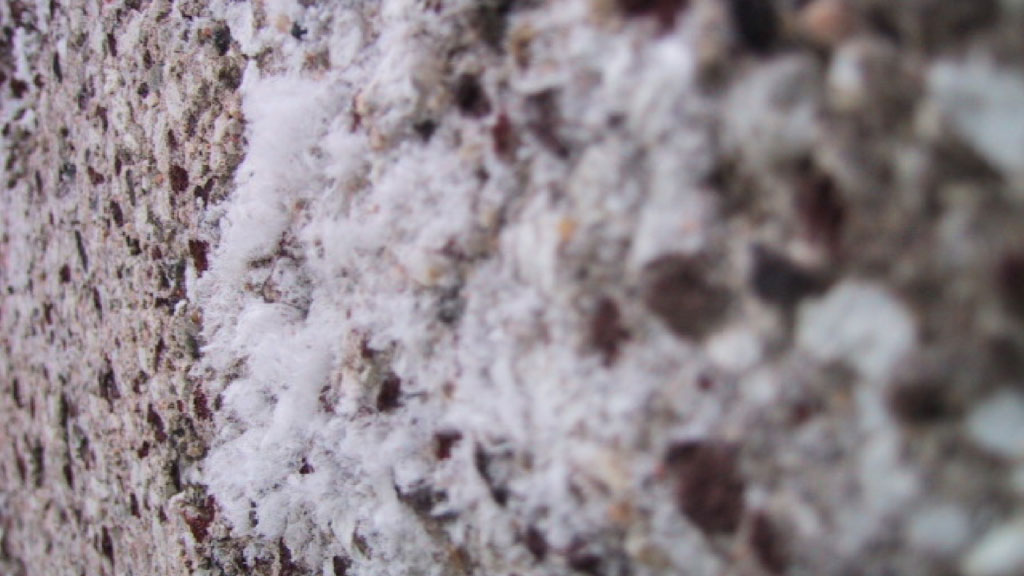
Close-up views of early-age efflorescence showing crystalline structure and needle-like forms.
Types of Efflorescence
There are two main types of masonry efflorescence. “New building bloom,” or primary efflorescence, appears as moisture leaves the wall in the first days and weeks after construction. These types of deposits are most typically white, poorly adhered crystalline salts that can be brushed off the wall by hand.
Secondary efflorescence, also called lime run, appears after months and years of moisture movement at areas where frequent moisture saturation occurs, such as near the tops of walls and at retaining walls. Hard, white deposits form when calcium minerals present within mortar, concrete block, and other cementitious products are dissolved by water and carried in aqueous solution to the wall face. Upon exposure to air, calcium combines with carbon dioxide (CO2), forming calcite (CaCO3) as hard, crystalline deposits, streaks, nodules, or even stalactites.
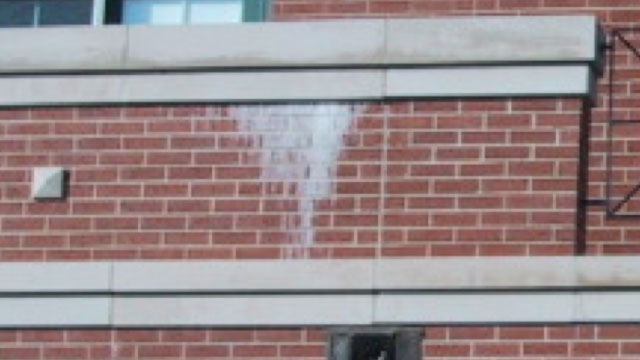
Calcite streaks are sometimes called “lime run”, appearing as a flow from moisture exit points.
Salt Source
Nearly all materials used to construct masonry contain at least a trace of efflorescence potential. Cement present in mortar, grout, and concrete block contribute soluble potassium, sulfate, and sodium alkalis, and additional salts may be carried to the wall through groundwater absorption or deposition of wind-borne contaminants. Hydrated lime used in mortar does not contribute to primary efflorescence but is available to form calcite deposits occurring as secondary efflorescence. Clay brick rarely contribute to efflorescence because manufacturers add special compounds to clays to render salts insoluble and unavailable to effloresce.
Cleaning Effect
Some of the most severe efflorescence problems appear after improper cleaning using acids. Used incorrectly, acid-based cleaning solutions will dissolve a much greater salt volume than water alone. Some of these compounds convert to forms that are insoluble in water and very difficult to remove. Green vanadium stains and brown magnesium stains form almost exclusively as a result of improper acid cleaning.
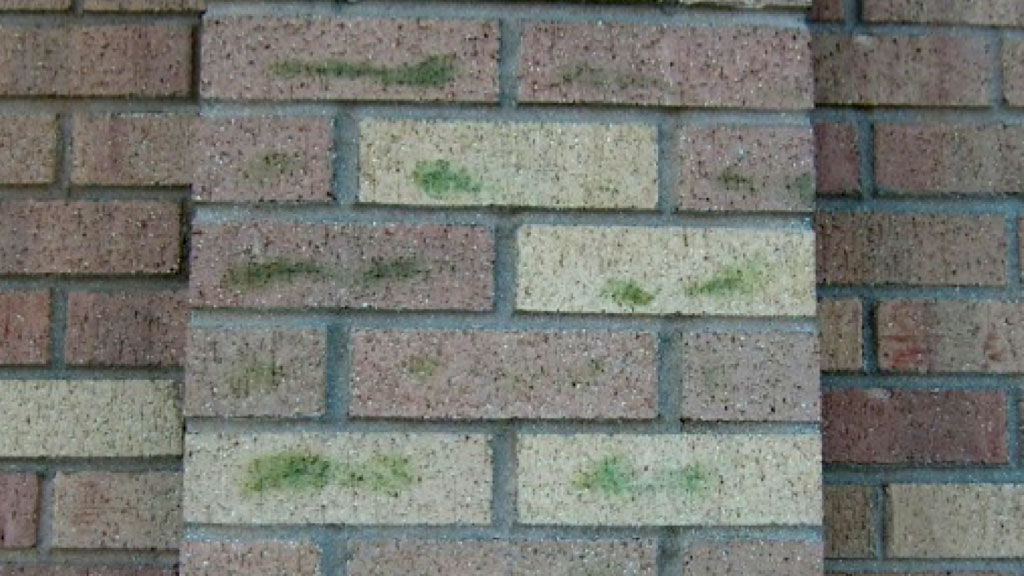
Green vanadium-based efflorescence and brown magnesium salts form almost exclusively as a result of acid washing.
Treating Efflorescence
The first step for treating masonry efflorescence is to identify the moisture source and conduct repairs to minimize moisture saturation. The next step is determining a proper cleaning approach. Many efflorescent salts are water soluble and will normally disappear on their own through weathering effects. Powdery primary efflorescence is best removed by brushing or using a light water rinse in warm, dry weather. Avoid cleaning with high pressure water or acid cleaners, which may dissolve more salts and force them deep into the wall where they are available for future efflorescence.
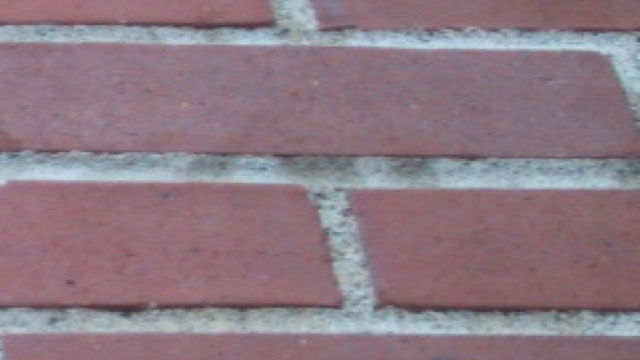
Green vanadium-based efflorescence and brown magnesium salts form almost exclusively as a result of acid washing.
Secondary efflorescence (calcite deposits) will require more aggressive cleaning. Avoid the impulse to use high pressure with aggressive acid cleaners – this may remove lime run but can be very damaging to the wall. The safest approach is to use commercially-available proprietary cleaning solutions, following best cleaning practices to prevent the cleaning solution from being absorbed into the wall. Talk to your masonry products representative to determine the best product to use for your application.