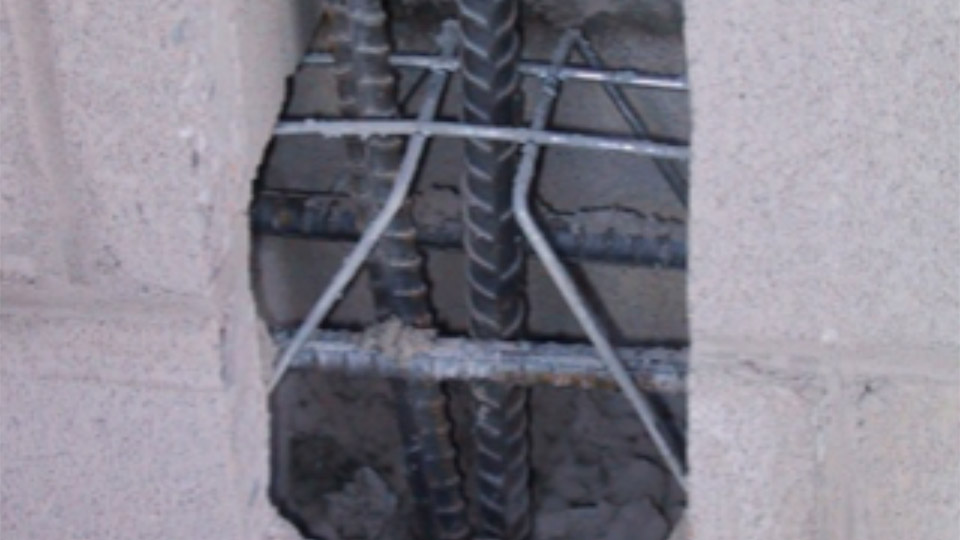
Rebar: Rebar Positioners

This cutaway view shows 2 vertical bars being held in place by a galvanized wire rebar positioner placed in the mortar joint. The bar positioner helps keeps the rebar from moving during grouting.
Rebar positioners are used to keep masonry wall reinforcement in the correct location. They come in many configurations, materials, shapes and sizes. Some project specifications require bar positioners and others don’t. They take time and money to install. Should you be using bar positioners?

Proper bar placement is critical for meeting the structural design. Misaligned bars reduce capacity of walls to resist lateral wind and seismic loads. Rebar placement tolerances for most designs are ±½” within the width of the wall and ±2” down the length of the wall (See TMS 602 Section 3.4 B.11.).

The 2013 Specification for Masonry Structures (TMS 602-13/ACI 530.1-13/ASCE 6-13) does not specifically mention bar positioners but does require reinforcement be placed in the grout space prior to grouting (see Section 3.2 E, that means no stabbing bars into freshly grouted masonry). The mason contractor must keep bars in place during grouting as required by TMS 602 Section 3.4 B.1: “Support reinforcement to prevent displacement caused by construction loads or by placement of grout or mortar, beyond the allowable tolerances.”

Older building codes were more explicit. The 1997 Uniform Building Code, for example, required “reinforcement shall be secured against displacement prior to grouting by wire positioners or other suitable devices at intervals not exceeding 200 bar diameters” (Section 2104.5). Some designers still have this concept in their specifications, and others may limit bar positioner placement to a maximum spacing of 10 feet.

When low-lift grouting techniques are used, you can see the bar extending above the grout pour at the top of the wall, and if that bar extension is vertical the probability of the rebar being displaced at the bottom of the lift is unlikely. With high-lift grouting, cleanouts at the base of the wall facilitate bar placement and inspection and most contractors will tie the vertical bar to foundation dowels to hold it in place. At the top of the wall vertical bars can be tied to bond beam steel but this is a bit risky – sometimes the bond beam bar moves during grouting, displacing all the vertical bars down the line.

The bottom line: you are required to build masonry walls with reinforcement located precisely as required by the structural design. Some contractors recognize how critical it is to have rebar in the correct place and will use bar positioners, others will not. Recognize that there is some risk to not using bar positioners – if rebar moves around during the grouting process you may fail the structural inspection, leading to costly delays and corrective action. Our advice to designers is to not specifically require bar positioners in project specifications, requiring instead that masonry reinforcement be placed according to TMS 602 Section 3.4. Leave it up to the mason contractor and their “means and methods” to ensure reinforcement is in the correct location as the wall is built.
No Shortcuts: The Journey of Real Stone
February 2026

Have you ever stopped and really thought about how that stone on the wall got there? I don’t mean the install...not the mortar, the scratch coat, or the clean-up. I mean the whole journey. From the first cut in the earth to the

Stop Gambling on the Wall: Why the Modern Jobsite Demands a Sure Thing
February 2026

If you have spent any time walking the carpeted aisles of the World of Concrete, you know the vibe. It is a sensory overload of heavy machinery, slick demos, and the collective optimism of thousands of contractors. We are in Las Vegas, the gambling capita

Helical Beaming: Strengthening Masonry from the Inside Out
February 2026

In the world of masonry restoration and retrofit, the goal is always the same: preserve the character and craftsmanship of historic structures while ensuring their long-term stability. But anyone who has worked on century-old brick or stone buildings know

The 2026 MCAA Annual Online Auction
February 2026

The Mason Contractors Association of America is thrilled to announce the 2026 Annual Online Auction, the masonry industry’s premier event for scoring the best equipment at a fraction of costs. Whether you are looking to expand your equipment stockpile or