Mortar and Grout: Inspecting for Grout and Rebar - After the Wall is Built
The inspector didn’t show up on the job but you kept building – now you are being told to tear down the wall because no one knows if the rebars are in the right place and if the grout is solid. What do you do now?
Luckily you have some nondestructive options for “post-construction inspection.” Some methods are very simple, while others are high-tech and require expensive equipment with experienced operators. If you hire someone to evaluate your wall make sure they have good masonry experience. Many test labs are used to scanning reinforced concrete and can get confused by all the complexity of a masonry wall.
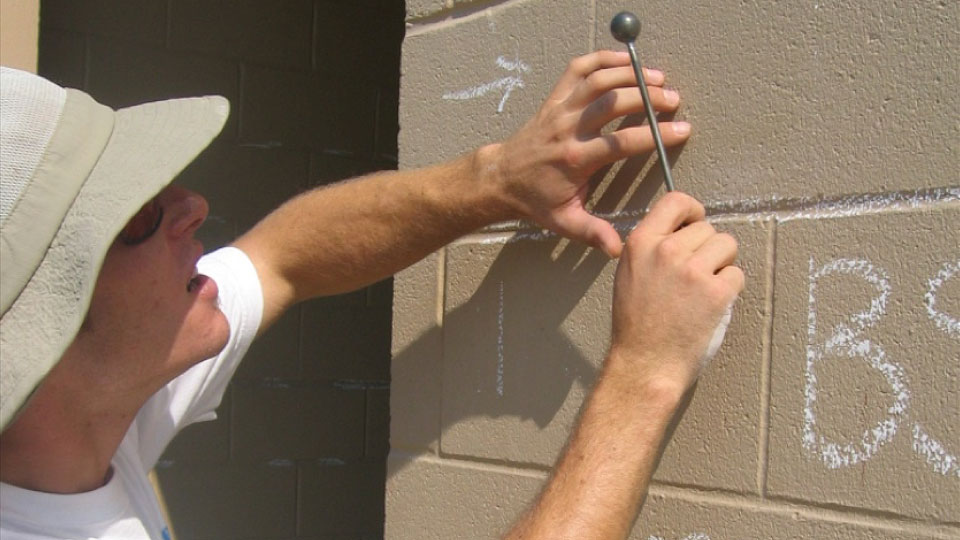
Sounding (tapping on the wall with a hammer) can be used to find solid grouted cells and near-surface voids.
If you have a good ear, sounding (tapping on the wall with a hammer) can be used to find solid grouted cells and near-surface voids. If you want to verify your findings, just drill a small hole to see if you hit solid grout or a void. Drill into mortar joints to simplify repairs.
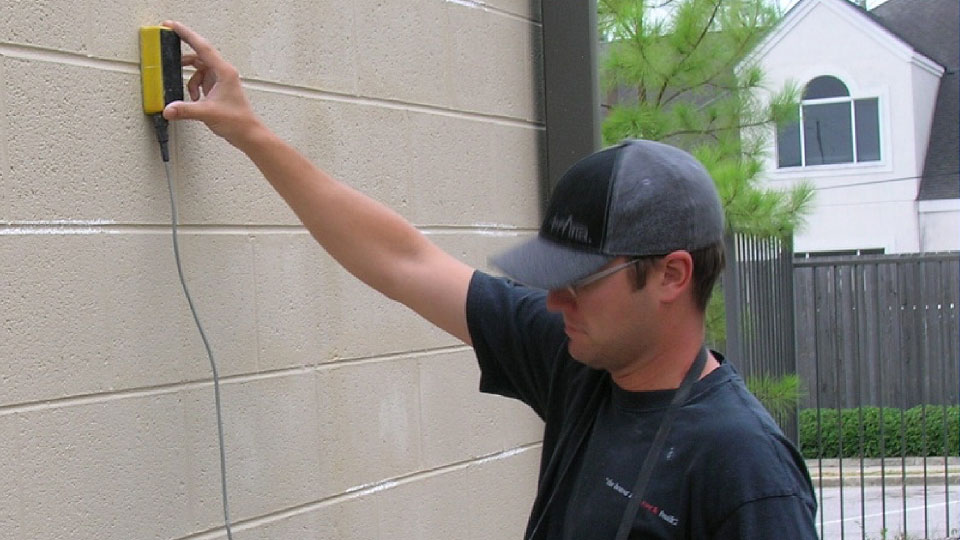
A pachometer is used to find metals in walls.
A pachometer (fancy metal detector) is used to find metals in walls, including veneer anchors, rebar, joint reinforcement, conduit, pipes, etc. Pachometers used for scanning reinforced concrete are good at finding bars up to 5 or 6 inches deep in the wall. The more expensive pachometers can tell bar size and depth of bars within walls.
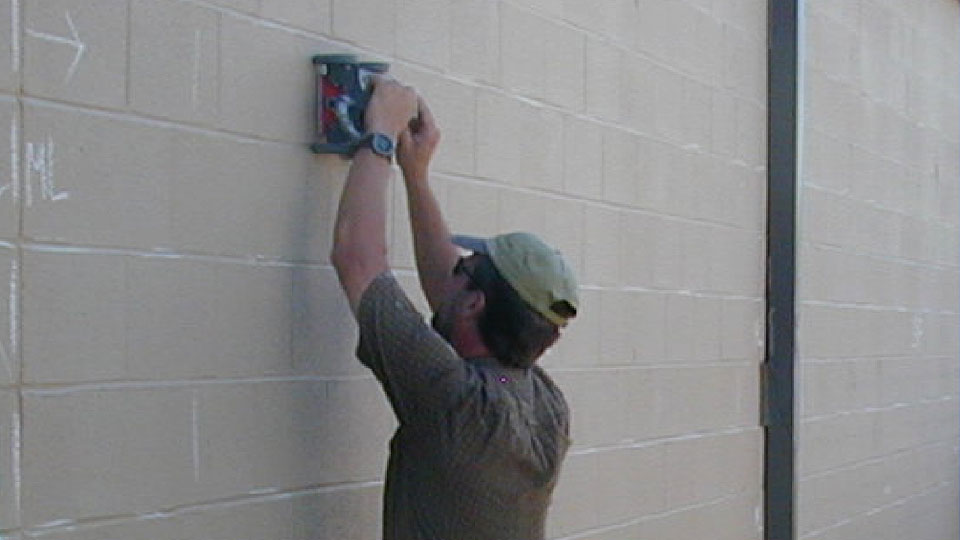
Surface penetrating radar is sensitive to metals and can also be used to find solid grout and voids deep within masonry walls.
Surface penetrating radar is sensitive to metals (such as rebar) and can also be used to find solid grout and voids deep within masonry walls. Scanning is carried out by rolling a radar antenna over the wall and interpreting reflections from metals, grout, voids, and other internal anomalies.
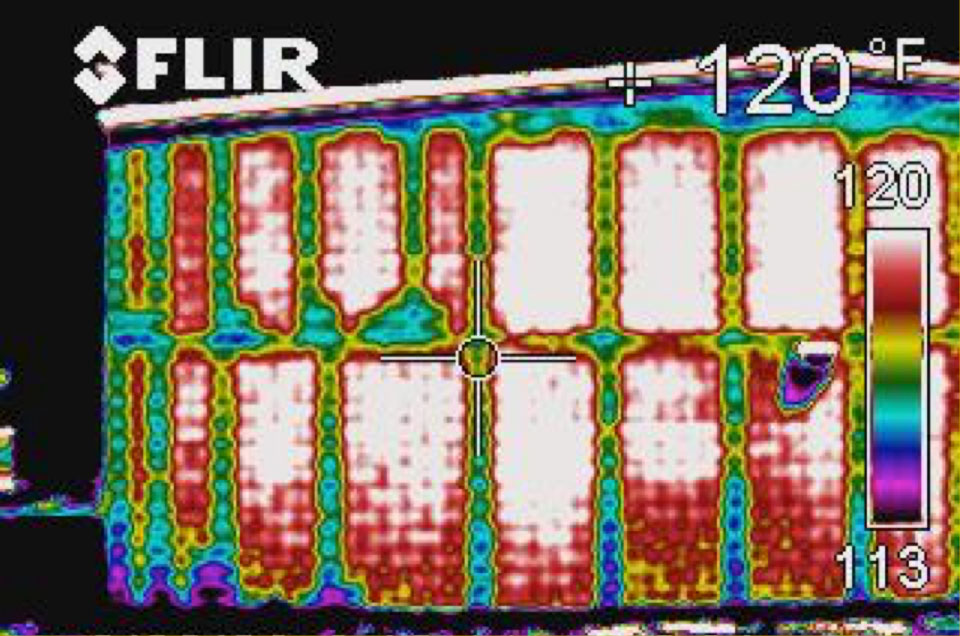
Infrared imaging using an infrared camera is a quick way to locate grouted cells in masonry walls.
If temperature conditions are right, infrared imaging using an infrared camera is a quick way to locate grouted cells in masonry walls. A temperature differential of 20 to 30 degrees from one side of the wall to the other usually gives good results. This image is of a partially grouted wall was heated by strong sunlight for about 3 hours. Grouted cells have high thermal mass and take longer to heat up than empty areas.