Inspection: Masonry Inspection
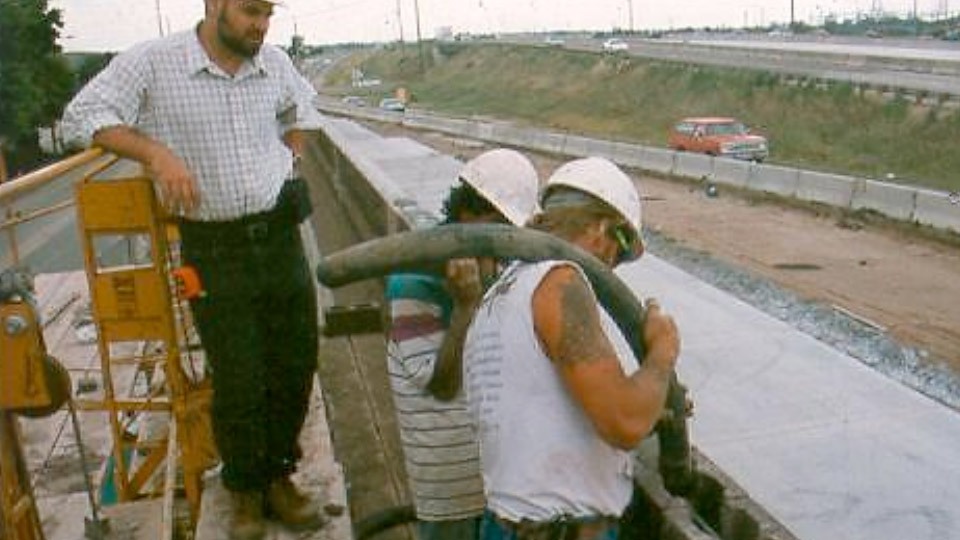
Continuous inspection of grouting operations is required by Level B and Level C quality assurance.
Years ago it was up to the architect or engineer to decide what level of inspection they wanted for their project. Under the current International Building Code system, the inspection level is dictated based on the building’s risk level and how the building was designed. Less inspection is required for buildings with little life safety risk, such as farm buildings and site walls. Higher inspection levels are required for essential facilities and buildings with greater failure consequences. Higher risk buildings include chemical storage facilities, hospitals, fire stations, and areas where large numbers of people gather.
Quality assurance (QA) is the process used by the building owner to assure that the constructed masonry complies with the design. This is different than quality control (QC) which is the contractor’s own approach to make sure his materials and workmanship meet contract documents.
QA Levels A, B, and C
QA requirements are covered in IBC Chapter 17. For masonry inspection, the IBC refers designers to the requirements of TMS 402 and TMS 602, Building Code Requirements and Specification for Masonry Structures. The minimum inspection level depends on the type of masonry (non-structural or structural), how the building was designed (non-engineered or engineered) and the building’s risk category (I, II, III, or IV). The combination of these 3 factors lead to one of three quality assurance levels as shown in the figure below.
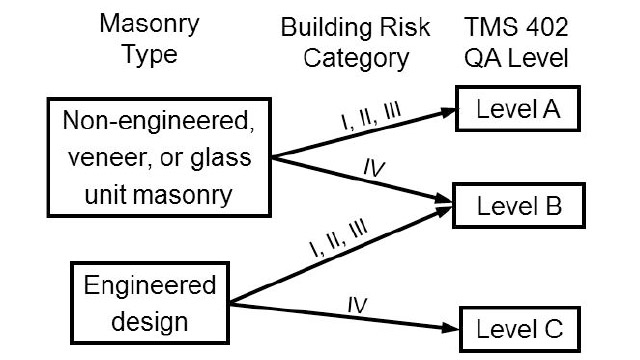
Quality Assurance Levels
Level B quality assurance applies to most load-bearing masonry construction. Of course designers can always choose a higher inspection level.
In simple terms, you can think of Level A inspection as not having any jobsite inspection requirements, Level B as being “periodic” inspection (for most items) and Level C as being “continuous” inspection for many items.
What Gets Inspected?
Most of the inspection required by code relates to items that may have an effect on structural capacity or building performance, such as construction of mortar joints, reinforcement placement, and grouting. Inspection of appearance-related issues such as colors and coursing patterns may be listed in contract documents but are not required by code. Some of the inspection items required by code are listed in the table below. See TMS 402 Section 1.19 for a full listing.
Level A QA has no requirements for jobsite inspection beyond verifying that submittals meet project requirements. Level B and Level C QA require the inspector to watch various parts of the masonry construction on either a periodic or continuous basis. Continuous inspection means just that – the inspector is viewing the work on a full time basis. For items requiring periodic inspection, the inspector will be on site on a part time basis, and will also view the completed work. The designer needs to define how often they want the inspector on site for periodic inspections as part of the QA plan.
| Minimum Inspection | Level A | Level B | Level C |
| Verify compliance with approved submittals | PT | PT | PT |
| Verify proportions of site-prepared mortars | | PT | PT |
| Construction of mortar joints | | PT | PT |
| Placement of masonry units | | | PT |
| Location of reinforcing, connectors and anchorages | | PT | PT |
| Grout space (prior to grouting) | | PT | PT |
| Grade, type, and size of reinforcing, anchor bolts and anchorages | | PT | PT |
| Verify proportions of site-prepared grout | | PT | PT |
| Size, type and location of attachments to other structural elements | | PT | PT |
| Size and location of structural elements | | PT | PT |
| Observe preparation prisms and grout or mortar specimens | | PT | PT |
| Grout Placement | | PT | PT |
PT – periodic FT – continuous
Masonry testing requirements also follow the three inspection levels, as shown in the table below.
| Required Tests and Submittals | Level A | Level B | Level C |
| Masonry material certificates | • | • | • |
| Verify masonry strength prior to construction | | • | • |
| Verify masonry strength during construction (1 per 5,000 sq. ft.) | | | • |
| Verify proportions of materials in mortar, grout, prestressing grout | | • | • |
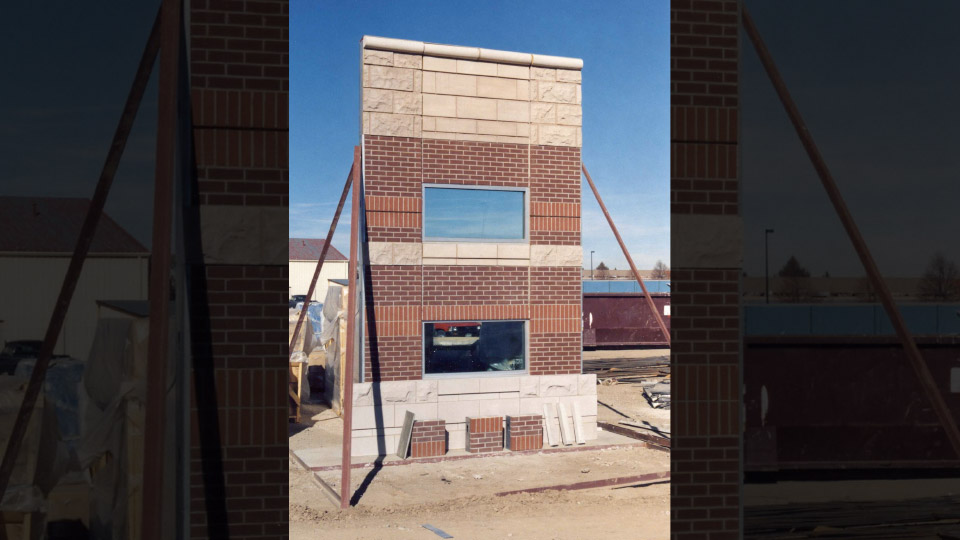
Code requires masonry samples (at least 4’ x 4’) for Level B and Level C quality assurance.
Inspector Qualifications
Not anyone can be a masonry inspector. According to the IBC, the inspector must be competent and have experience with the type of construction and inspection level being used on the project. Check to see if the inspector has experience with previous masonry projects, or has passed the International Code Council’s (ICC) test to qualify as an ICC “Structural Masonry Inspector.” Visit iccsafe.org and click on the Education and Certification tab to search for qualified inspectors in your area. The Masonry Society also has training courses for masonry inspectors and a new program to certify masonry test lab personnel (www.masonrysociety.org).
Contractor Duties
It is not the contractor’s responsibility to lay out the inspection plan – this should be done by the designer and listed in the project specifications or in General Notes on the drawings. The contractor does have some responsibilities, mainly to facilitate the QA process. This includes providing access to the work area, making masonry prisms for the test lab to test, and providing a space on site for storing test specimens once they are made. See TMS 602 Section 1.6 C for a full list of contractor duties.
Finally, many contractors believe that they are not liable if the inspector misses something during QA. Be careful – the Code is very clear that the contractor has the primary responsibility for meeting design requirements!