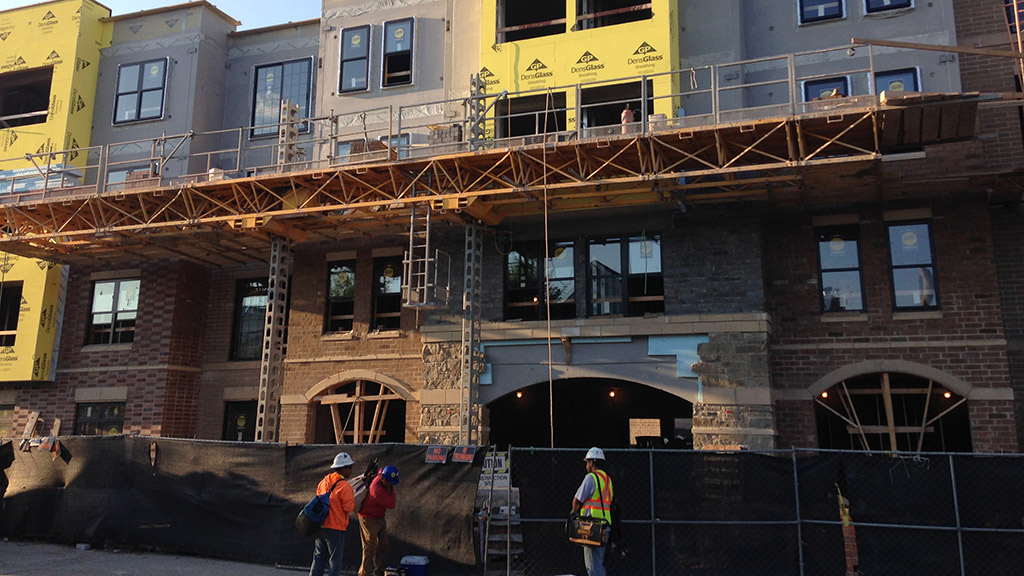
A new face for senior housing

Words: Maureen CampbellWhen The Renaissance Companies of Chicago developed the concept for the Kilpatrick Renaissance, an apartment complex for seniors aged 55 and over, its leadership immediately called upon general contractor Sterling Renaissance Inc. of Lake Zurich, Ill., and Worn Jerabek Wiltse Architects of Chicago. Together, the team conceptualized, analyzed and streamlined the design and building processes, negating any challenges that occurred.

“Bringing our team together at the onset really made the process better,” says Jeanmarie Kapp, COO of family-owned and women-owned Renaissance Companies. “With everyone at the table from the start, we are able to discuss cost, design materials and more. This helped during the entire process as problem areas were already worked out.”

In the end, the team built the Kilpatrick Renaissance in the Portage Park section of Chicago to include 98 senior-living apartments within its four stories. Keeping in line with the core values of The Renaissance Companies, 90 percent of these units are affordable housing, while the other 10 percent are high-end.

“We don’t think affordable housing has to look like affordable housing,” Kapp says.

And at the Kilpatrick Renaissance, the building team definitely achieved that goal. It is obvious from the intricate details included on the face, the complexity in design, and the breadth of materials incorporated into the skin that the team approach implemented by Kapp has balanced a sophisticated look with affordable pricing.

The Kilpatrick team has blended various structural and architectural elements, creating disparate faces within each side of the building. These individual faces are highlighted through the use of color and texture. While the look is eye-catching, the exterior construction process was quite detailed.

Kapp and architects Todd Wiltse and Michelle Dresden traveled to the Illinois Brick Co. to hand-select each brick type, texture and color to be used on the individual faces of the building. In all, Yankee Hill, Cloud Ceramics, Sioux City, Glen-Gery and Heritage bricks were selected in seven different colors and four different textures. The brickwork was complemented by stonework, such as Accucast Stone and Semco Stone, in three different colors and multiple sizes. All the pieces were fastened together by two distinct types of mortar.

Mason LCS Construction of Franklin Park, Ill., was tasked by builder Sterling Renaissance with assembling the facing puzzle.
In order to truly execute the skin design, mason LCS Construction of Franklin Park, Ill., was tasked by builder Sterling Renaissance with assembling the facing puzzle.

“Incorporating all the different layouts — and matching all the different colors of masonry with the appropriate mortar — required attention and coordination,” says Ken Littwin Jr., president and owner of LCS Construction. “You can really see this detail on one face of the building. A brick checkerboard was designed in this section, and we had to be precise. If one brick was off, the whole wall was off.”

As the building was designed to meet the standards of the Energy Star Multi-Family High Rise Code, Littwin and his team worked with Sterling Renaissance to ensure that the ratings were achieved. Aligning these energy-efficiency requirements with the complex skin and pre-cast concrete construction presented interesting challenges, including the insertion of the windows.

The exterior of the Kilpatrick Renaissance was comprised of an eight-inch, solid concrete wall, to which three inches of foam insulation was added. Building codes require that 1.5 inches of space be allowed for drainage before the application of a 3 ⅝-inch brick face. Though the 16 inches of exterior wall was necessary, construction plans still called for the windows to be set back from the brick face.

“Due to the requirements necessary for the pre-cast concrete building, the window had to be attached to the concrete,” says Bruce Sterling, EVP of Sterling Renaissance. “To solve that dilemma, we created a wood sub buck to provide a place to anchor the window. But we needed to ensure that no water could get into the buck.”

Littwin and his team were instrumental in this process. “We sealed the bucks with a water barrier before we wrapped them, ensuring they were waterproof. Once this was complete, we were able to secure the energy-efficient windows to the bucks.”

With the successful execution of the intricate skin and the innovative solution to securing the windows to the concrete, the building team was able to achieve the original vision of Jeanmarie Kapp and The Renaissance Companies. An attractive project was built that provides seniors aged 55 and over with affordable housing and a convenient location.

“And,” Kapp adds, “the outside is just the beginning.”
From Day One to Long-Term Success: Onboarding Strategies for Contractors
January 2026

The construction industry is facing one of its toughest challenges in decades. Companies are struggling to find enough skilled workers while competing to keep the ones they have. At the same time, projects are becoming more complex, deadlines are tighter,

Finding the Right PPE for Your Work
January 2026

When it comes to PPE, one thing’s for sure: safety isn’t one size fits all. The work you’re doing, where you’re doing it, and even what time of year it is, can all make a big difference in what gear actually works. Price, comfort, and job performance all

Back Injuries: The Real Cost and How to Prevent Them
January 2026

The mention of back injuries makes mason contractors cringe, and for good reason. Masons lift heavy objects every day, all day long. When a person sustains a back injury, it is serious. It affects every part of their life, from their ability to perform wo

Detailing for Durability: The 2026 Guide to High-Performance Stone Veneer Transitions
January 2026

Some of the most expensive failures involving manufactured stone veneer installations don’t come from the stone at all, but rather from the material transitions and flashing around it. Transitions are weak points in the overall cladding where water can fi