Cleaning the Nebraska State Capitol

Words: John Smith Jr.For years preservationists have had to rely on invasive and labor-intensive techniques to clean masonry structures. With the recent restoration projects at the Nebraska State Capitol, preservation staff looked for the latest developments in masonry cleaning. These techniques were tested for effectiveness to clean and preserve the Capitol.

At the 1998 beginning of the Exterior Masonry Restoration Project, architectural consultants advised using a new cleaning technique, “Façade Gommage.” The technique uses a mineral abrasive that is the consistency of talc to clean the tower façade, rather than sand blasting as was previously done in the 1970s. The premise being that the aluminum oxide abrasive would remove the algae and dirt only, rather than clean and etch the surface as sand blasting does.

Further testing on the base of the building revealed that the soiling and algae on the exterior could be removed successfully by first applying a biocide treatment, and then high-pressure washing. The research and testing of cleaning techniques on the exterior limestone facade resulted in the most effective and least invasive technique being used to clean the Nebraska Capitol’s Indiana Limestone exterior.

The soiling on the interior walls of the Capitol results from a different set of circumstances than those affecting the exterior. There are three kinds of interior soiling to be addressed. Discoloration of the limestone is a result of mineral staining from leaks, soiling from indoor air pollution and soiling from human contact with surfaces. Humans excrete acids and oils that are absorbed by the porous limestone surfaces when touched by hands and other parts of the body.

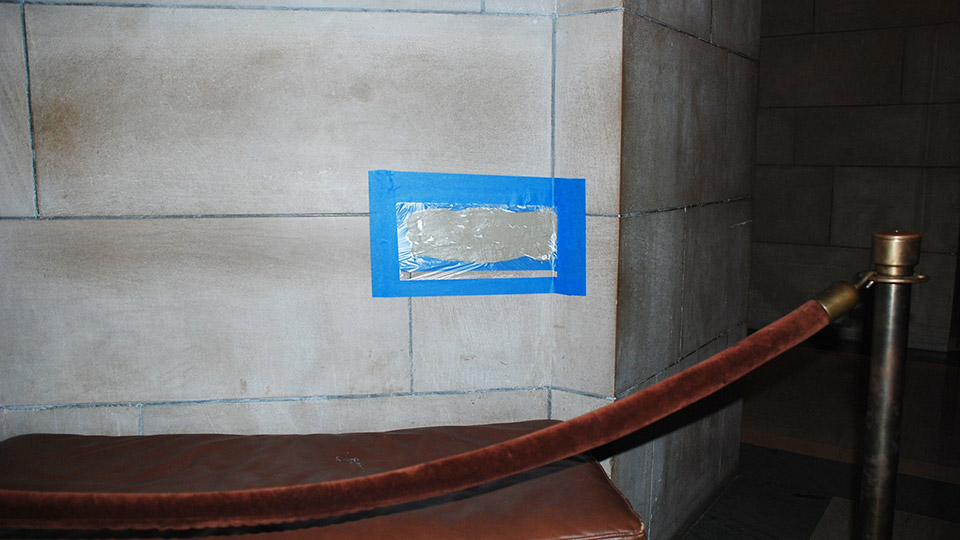
Poultice application: A mason tests a spot to remove body oil from the wall behind an elevator bench.
These three types of soiling have different chemical compositions. Capitol conservation staff members have tried different techniques to clean the interior walls, from scrubbing with soap and water to applying a clay poultice. Both of these methods require extensive preparation to protect the surrounding surfaces — large quantities of water that may further damage surfaces and then more cleanup of the work site.

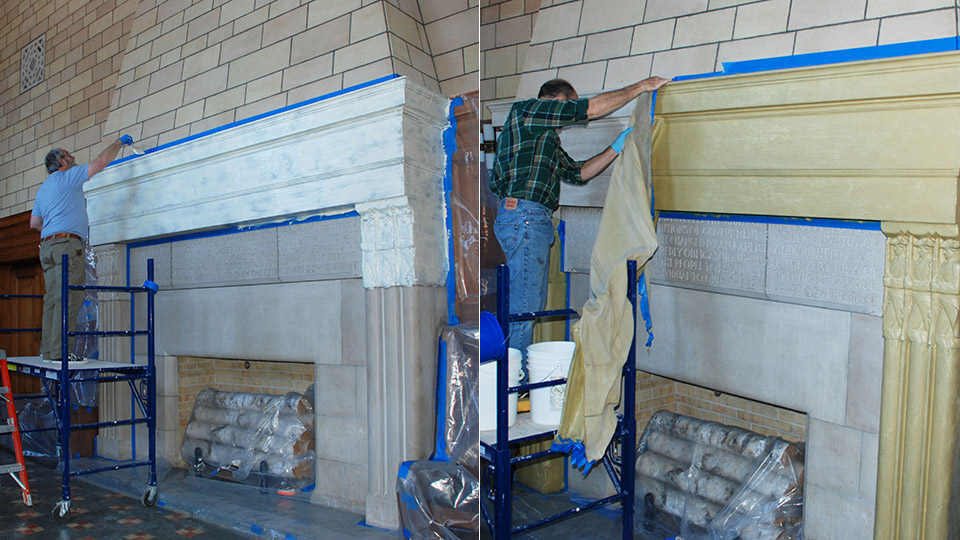
An integrated latex/detergent poultice product was successful in cleaning the water stains and overall soiling on the walls of the George W. Norris Legislative Chamber with minimal negative impact.
During the planning of the 2008 West Chamber Restoration Project, Capitol Preservation staff and consultants looked for an interior cleaning product that would be effective and less invasive. They did not want water spray or clay dust spread throughout the highly finished legislative chamber and onto the finished surfaces of the walnut desks, gold leafed ceiling and wool carpet. A new integrated latex/detergent poultice product was successful in cleaning the water stains and overall soiling on the
walls of the George W. Norris Legislative Chamber with minimal negative impact.

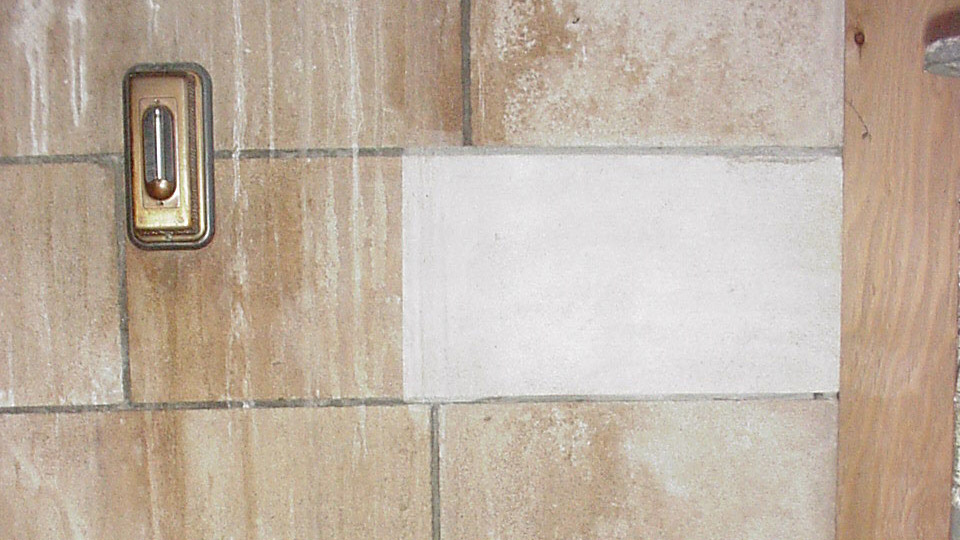
Mineral deposits from leak are cleaned.
In 2009, a conservation consultant and Capitol conservation staff continued testing of the latex/detergent product in two areas of significant mineral staining. Because a new copper roof was installed over the southwest quadrant, conditions that had allowed the staining to occur were resolved, and cleaning began in the southwest elevator vestibule on third floor. This cleaning proved successful, and work moved to the third floor southeast stairwell.

The latex/detergent poultice has successfully cleaned all soiling conditions, the mineral deposits, general soiling from smoke and air born particles, and hand soiling on the limestone surfaces. Capitol preservation staff members now have another tool to use in their ongoing work to clean and preserve the Nebraska State Capitol.
GEN NXT: Mason Paolini
May 2026

This month, the MCAA got to talk with Mason Paolini, a mason who has a clear passion and talent for the trade he has such high praise for. Read about Mason’s story and why he sees a future in this industry. Mason Paolini’s career began with a simple desi

Marvelous Masonry: Tianjin Zhongshuge Library
May 2026

It is not unusual today for masonry to be treated as a surface decision rather than a structural one. Too often, brick enters a project late in the process, trimmed back by budgets or reduced to a veneer once the “real” building work is finished. The Tian

Fechino Files: Concrete Pavers around a Pool
May 2026

Many folks over the years have placed concrete pavers around their pool as a nice form of decorative pool deck. Early in the 2000’s, I took a class held by the Interlocking Concrete Paver Institute, then known as the ICPI. At the time I attended the class

Chairman's Message: Staying the Course
May 2026

Spring is one of my favorite times of year. There’s energy in the air. Jobs are picking up. Crews are hitting their rhythm. Schedules are filling up. You can feel momentum building again. And every year around this time, I find myself thinking about con