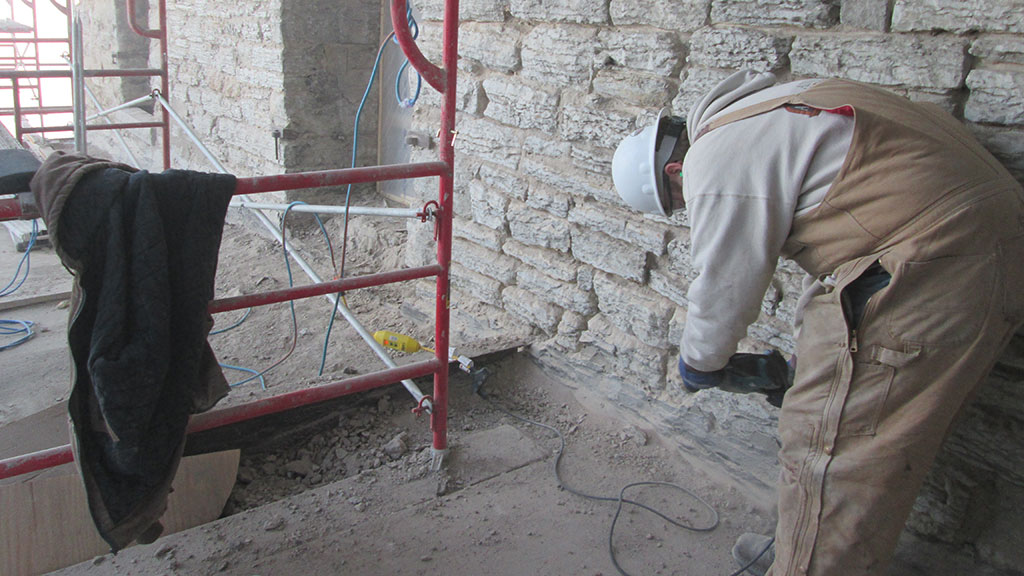
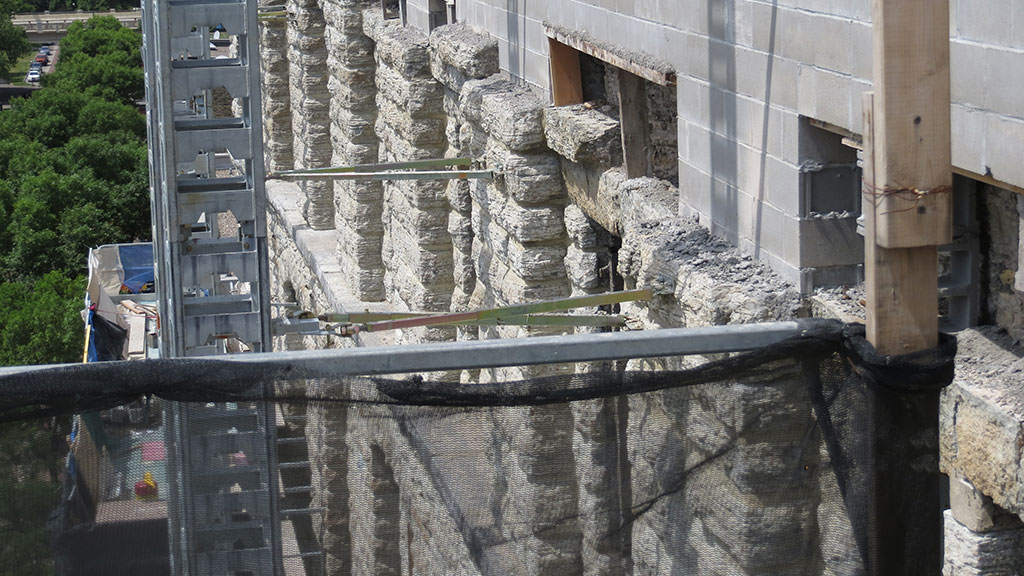
Pillsbury A-Mill Artists’ Lofts Get a Lift Words: Tim AbbottThe Pillsbury A-Mill was erected in 1881 in Minneapolis, Minn., and operated two of the most powerful direct-drive waterwheels ever built. It was listed on the National Register of Historic places in 1966 – one of the earliest registrations. Coincidentally, buildings built in 1966 are now eligible for listing on the National Register. The original purpose of the building, which was owned by the familiar Pillsbury family, was to mill flour. Purchased in 2012 by Dominium Management, the goal was to take the dilapidated building and turn it into affordable artists’ lofts, preserving the exterior as it originally appeared. The complete exterior restoration of the building was central to the overall project and to the historic Mill District of Minneapolis. Advanced Masonry Restoration, Inc. (AMR) was called in to perform all phases of restoration, from masonry to stone and concrete repair. Parapet Repair and Removal The existing stone parapet was a “Platteville limestone” of multi-width construction. The parapet was removed from the top down six feet, and the attic area above. A new core-filled interior block wall was installed, and the exterior finish was a “Lannon Pewter Gray limestone,” quarried near Green Bay, Wis. It was chosen for its close match to the existing remaining Platteville limestone. More than 1,500 square feet of new stone was installed on top of the building, along with the block, mortar and rebar to install a new wall. AMR journeyman PCC Craig Lundberg removes old mortar to prepare for the installation of crafted joints that replicate the original work. Stone Sill Replacement All of the window sills were removed and replaced with the same Lannon Pewter Gray limestone. In addition, during the period of significance, a concrete wash was installed, and AMR replicated the concrete sills in both design and material. Repointing Each and every stone mortar joint was removed and replaced on the exterior. The majority of the stone joints were finished with a struck/doweled joint that was slightly concave and matched the original interior mortar color. When it came to the Main Street elevation below the revitalized canopy, the joints were repointed with a raised joint using a tool fabricated by AMR to match historic photos and records. This was done to show that, at one time, the entire building may have had this raised joint on it. As an interesting side note, the Main Street elevation has a bow in it extending out about 6—8 inches across the elevation. Within a few years after the building was built, whalers were installed to keep the building from moving. On the opposite side, concrete bracing was poured to stabilize the building. The concrete was restored by AMR and is visible on the east elevation. Progress on the parapet wall. Over 2,000 stones were replaced, along with a new block interior wall. Rebuilding of Windows and Stone Replacement Several windows were rebuilt to original specifications to correct modifications that were made over the years. AMR successfully restored several arched windows to their original condition. Cleaning Cleaning of the building was completed under the auspices of the Secretary of the Interior Standards, and no acid-containing or other harsh chemical agents were used in the cleaning process. The project was completed in 2015, and each added year will enhance the restoration to replicate the original condition.