Wall assemblies and code requirements

Words: Herbert AndradeIn a construction environment challenged by ever-increasing permit and code requirements, one principle remains steadfast: the size of a building project does not necessarily correlate to the complexity of the project. At less than 500 square feet, a recent addtion to St. Stephen’s Episcopal Church in Boston ranks among the smallest pro bono projects Cameron Roberts, principal of Cameron Roberts Advisors, has undertaken in a career that spans more than 25 years. Yet, the addition also represents one of the most complex projects Roberts has managed, when viewed through the lens of building envelope codes and permits.

A matrix of code requirements

Tucked into one of Boston’s historic neighborhoods, the St. Stephens Episcopal Church addition presented Roberts with a matrix of requirements, including both aesthetic and building science considerations.

From an aesthetic perspective, the addition’s design needed to complement the existing 19th century architectural style defined by red brick, granite and cornices. Practicality was also a consideration.The vibrant church serves 350 local youths and operates seven days a week, so the site was occupied by staff, congregants and youth program partcipants throughout the construction phase.

The biggest challenge faced by building professionals working on the addition pertained to the building envelope — specifically to specifing a two-hour rated exterior masonry wall assembly that could meet all of the code provisions in an urban setting subject to a great deal of permitting. Beyond complying with structural requirements, the building envelope was subject to NFPA 285, energy code requirements for insulation in the walls, implementation of a waterproofing system and air infiltration requirements.

“We were faced with a matrix of requirements that needed to be met simultaneously,” Roberts says.

After researching multiple component manufacturers, Roberts considered retaining a building envelope consultant to address the challenging code requirements. He had engaged building envelope consultants in the past and was ready to go the consultant route again, when he came across an article about CavityComplete Wall Systems by Owens Corning in a trade magazine.

“The CavityComplete Wall System was a revelation,” he says, adding that the wall system complied with all of the codes that the St. Stephen’s addition was required to meet. Another challenge was checked off the list, and the addition was one step closer to getting started.

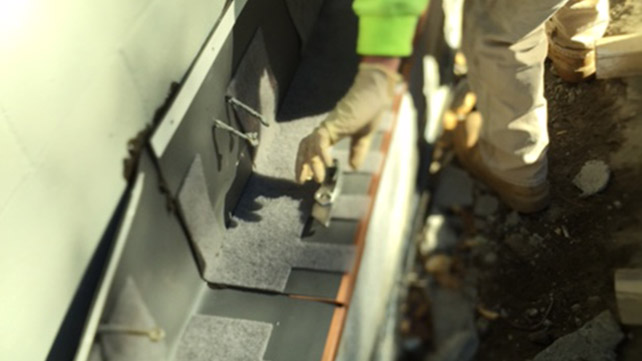
Labor saving TotalFlash through wall flashing and water management system being installed. (Note: When unavoidable penetrations occur, such as in the flashing membrane, CavityComplete Wall Systems provide MPE-1, a sealant that is fully tested for adhesion and compatibility to solve unusual job site sealing conditions that arise.)

A system-driven approach to wall assemblies

Introduced in 2014, CavityComplete Wall Systems, masonry veneer over steel stud, wood stud or concrete masonry unit (CMU) backup, allow architects to easily specify and detail high-performance assemblies with components that are tested, proven and fully documented to be completely compatible, code compliant and warrantied (see limited warranty at www.CavityComplete.com) to perform together. The wall system components were tested and found to be fully compatible with each other in each system.

While providing building professionals with a solution for addressing complex code environments, the CavityComplete Wall System was also developed to save architects and specifiers time and minimize the risk for errors and omissions. The system brings together components from Owens Corning Sales, Heckmann Building Products, Mortar Net Solutions, Rodenhouse, and Tremco.

The system meets a real need for architects specifying wall assemblies, says to Roberts. “Wall technology is the most challenging frontier in building design,” he says. But he is not surprised that a manufacturer developed the systems-based approach to wall assembly, noting that historically manufacturers have led the way in terms of addressing code compliance while the design community has typically not been involved in addressing the issues.

“Over the past 10 years, we’ve seen that manufacturers are typically the first responders when it comes to getting ahead of the code system,” he says.

Building confidence into the job

Of course, specifying a building’s wall assembly is only part of the project. The assembly also needs to be properly installed. For more than 45 years, Leo Lliberte, owner of Laliberte Construction Associates Inc. in Kingston, Mass., has served as a contractor in both the residential and commercial sector along with specializing in structural repair work.

Laliberte embraced the complex code challenges presented by the St. Stephen’s addition. “I like taking on the challenging jobs no one else likes to do,” he says.

Moisture control — specifically avoiding water infiltration in the walls — was a consideration that Laliberte was particularly interested in addressing. St. Stephens is located next to a high-rise apartment and water run-off issues have arisen in the past.

“Storms and humidity are a big problem in New England, and protecting against moisture infiltration can prevent a lot of maintance problems in the future,” he says, recalling the period in the 1980s, when some builders insulated extensively and then wrapped walls in plastic before putting up the sheet rock and plaster, allowing moisture to build up.

“That was a nightmare,” he recalls. The St. Stephens addition was the first time Laliberte’s company had used the CavityComplete Wall System, and he said the system was easy to install. “Once you learn the proper steps, it’s very easy to work with and apply, and it’s especially comforting to know that once the job is done, you don’t have to worry about moisture infiltration.”

Architects also encounter questions during the building process and Roberts praises the technical support and warranty backing the systemized wall approach.

“The completely compatible warranty is new,” he says. “Normally, architects are dependent on consultants to tell them what component might be causing the problem. The CavityComplete warranty covers all of the components in the wall system, and it is backed up by a team of technical experts. There’s no need to figure out which component expert to consult when it comes to warranty questions. And, technical expertise is crucial when it comes to maintaining credibility on site.”

Assurance and confidence for building owners

While CavityComplete is a wall system that helps building professionals specify systems confidently, Laliberte says the sytem also offers assurance to building occupants by reducing the maintenance costs associated with water damage and reducing energy costs (actual saving vary). In addition to dealing with humidity in the Northeast, the CavityComplete Wall System is well suited to the southern climate as it helps walls retain less humidity, which in turn helps a building’s air conditioning system operate more efficiently.
Manufactured Stone Veneer Trends for 2026: What’s Next in Stone & Masonry Aesthetics
December 2025

As design trends evolve, stone and masonry continue to stand at the intersection of artistry, performance, and innovation. For 2026, manufactured stone veneer (MSV) is emerging as one of the most dynamic materials in the exterior and interior design space

Construction Robotics Upgrades to Gold in the 2026 Masonry Alliance Program
December 2025

The Mason Contractors Association of America (MCAA) is delighted to share that Construction Robotics will upgrade their Silver partnership to a Gold partnership in the 2026 Masonry Alliance Program.

MASONRY STRONG Podcast, Episode 34 Recap: Major Ogilvie, CEO at Ogilvie Strategies, LLC
December 2025

On this episode of the MASONRY STRONG Podcast, Major Ogilvie joins the set to talk about his days playing football in college, how his journey started, and how he's seen the masonry industry change over the years.

Building the Future of the Trades: STABILA’s International Social Media Day and Verified Social Channels Are Inspiring the Next Generation
December 2025

In an era when social media often shapes public perception more than traditional media, even the most time-honored trades are finding new ways to connect, educate, and inspire. STABILA, a global name synonymous with precision measurement tools is trusted